A mother carrying her dead child through the street is one of the hardest images any story can give you. It stays with you because grief often looks exactly like this, raw, public, and impossible to reason with.
The story of Kisa Gotami is short, but it reaches a truth many people spend years trying to face. Her pain does not disappear, yet its meaning changes. That change is where the story draws its power.
A mother who refused to accept death
Kisa Gotami had lost her young son, and she could not accept that he was gone. Her sorrow was so complete that she moved through the village with his body in her arms, asking strangers for medicine that could bring him back.
That detail matters because grief does not always begin with calm acceptance. Sometimes it begins with refusal. A mind in shock keeps searching for one more answer, one more healer, one more chance to undo what has happened. Kisa Gotami’s actions were extreme, yet the feeling behind them is familiar. Loss can make even the impossible feel worth chasing.
People turned her away. Some likely saw her pain and had no words for it. Others may have known there was no cure to give. Either way, she kept moving from house to house because hope, even broken hope, can keep a grieving person on their feet longer than reason can.
Her story does not mock that desperation. It shows it plainly. A mother who loved her son could not let go of him because love had made separation unbearable.
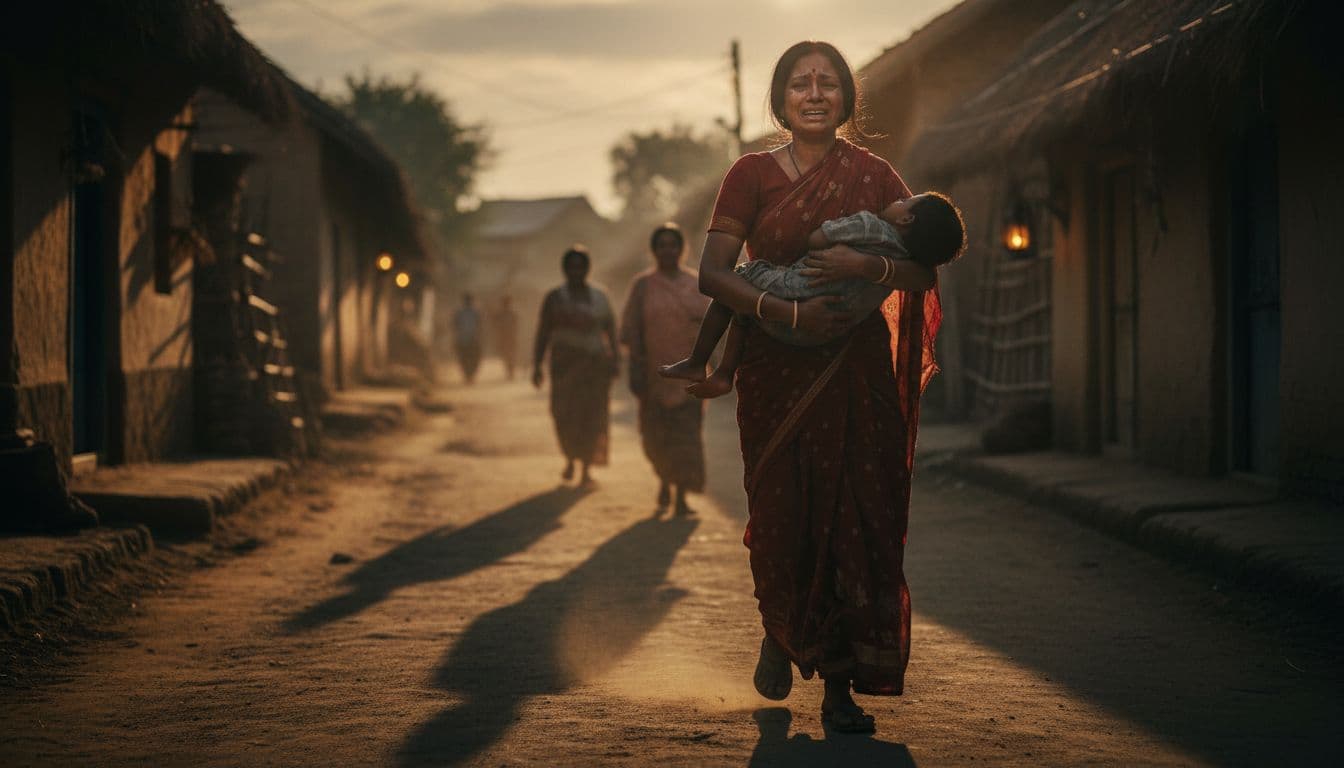
Someone finally directed her to Buddha. That moment shifts the story. Until then, she had been searching for a cure. Soon, she would be led toward something harder and more lasting than a cure, the truth that suffering is shared.
Buddha did not argue with her grief
When Kisa Gotami came before Buddha, she knelt with her child still in her arms. She asked for help, and Buddha did not reject her. He did not lecture her about death. He did not tell her to stop crying or to accept reality on command.
Instead, he answered with a task.
“Bring me mustard seeds, but only from a house where no one has ever died.”
At first, the request must have sounded possible. Mustard seeds were ordinary. She was not being asked to climb a mountain or cross a river. She was being sent back into the same village she had already walked through, only now with one condition attached.
That condition changed everything.
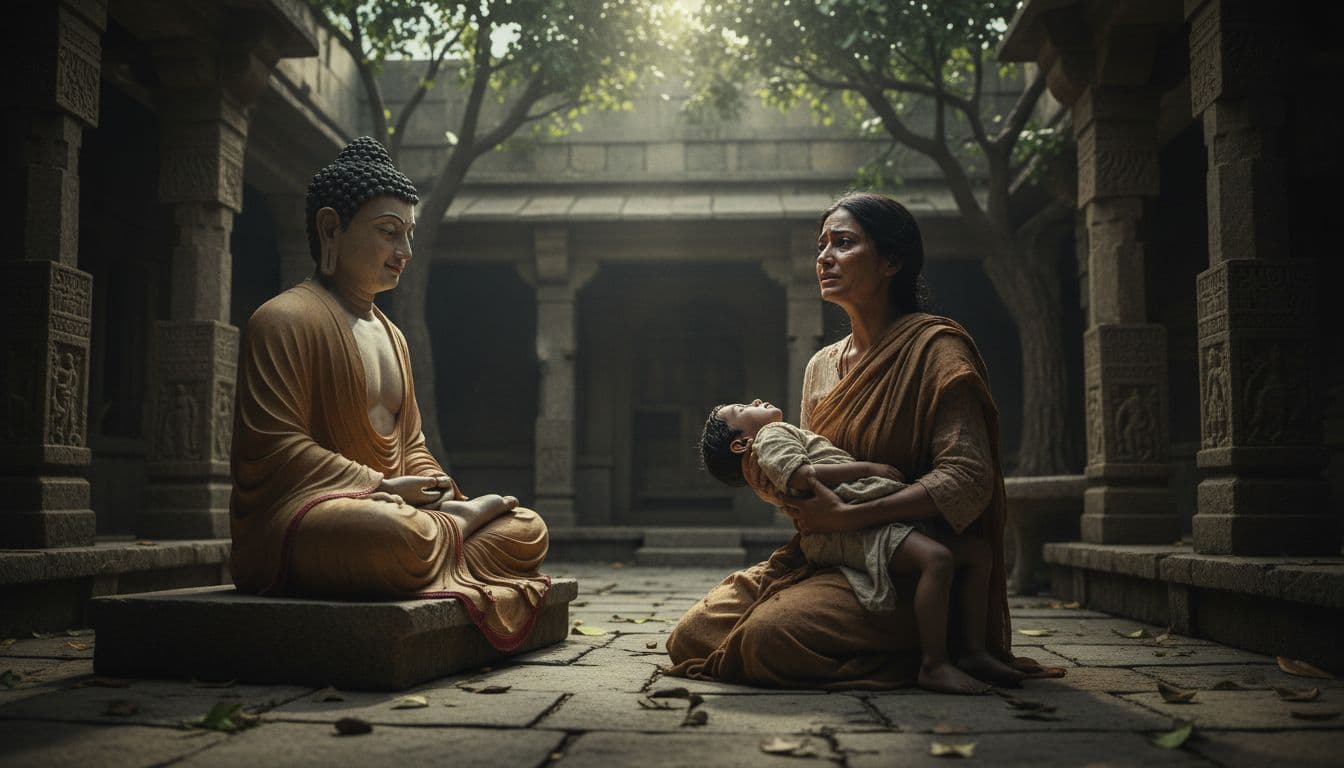
Buddha’s response is gentle because it meets her where she is. A direct statement about impermanence might not have reached her. In the first heat of grief, words often bounce off the mind. Experience reaches deeper. So he gives her a path that lets reality reveal itself one door at a time.
His smile, mentioned at the end of the story, begins to make sense here. It was not the smile of distance or indifference. It belonged to someone who could already see the insight waiting for her, even while she still could not.
The search through the village changed the meaning of her loss
Kisa Gotami went from home to home asking for mustard seeds from a family untouched by death. She searched every house in the village. At each stop, she found the same answer in a different form.
One family had lost a parent. Another had buried a child. Somewhere else, a husband or wife was gone. The names changed, but the fact did not.
- In one home, death had taken a parent.
- In another, it had taken a child.
- In another, it had taken a spouse.
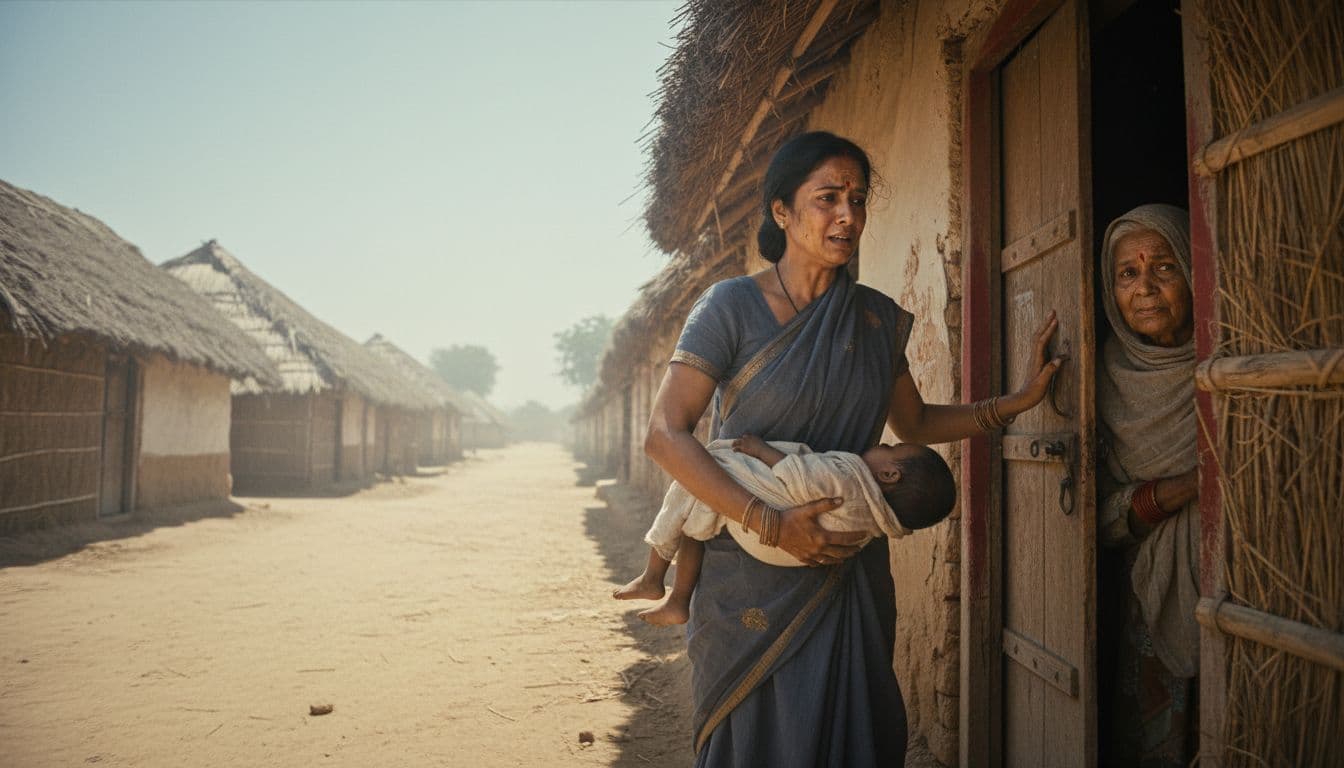
Each conversation moved her a little farther from private panic and a little closer to a shared human fact. The village was full of sorrow. Not the same sorrow, because no two losses are identical, but sorrow all the same. Her pain had not singled her out for punishment. She had entered a condition that every household already knew.
By nightfall, she returned with no mustard seeds. Outwardly, she had failed. Inwardly, something had broken open. She came back changed because the search had done what no argument could do. It showed her that death had visited everyone.
The story turns on that quiet reversal. She began the day looking for an exception to death. She ended it knowing there was none.
Why Buddha smiled
The smile in this story is easy to misunderstand if it is taken out of context. Buddha did not smile at a grieving mother’s pain. He smiled at the moment her isolation began to lift.
Before the search, Kisa Gotami carried two burdens at once. One was the death of her son. The other was the belief that her suffering stood apart, as if fate had chosen her alone. That second burden often makes grief harder. It traps pain inside a private room and closes the door.
After walking through the village, she could no longer believe that. She had heard the same wound echo through many homes. Her sorrow remained, but it was no longer cut off from the rest of human life.
A simple comparison makes the turning point clear:
| What Kisa Gotami wanted | What Buddha asked for | What she discovered |
|---|---|---|
| Medicine to restore her son | Mustard seeds from a house untouched by death | No home was untouched by loss |
That is why the smile matters. It marks recognition. Buddha could see that understanding had entered where denial had stood.
Buddha smiled at the moment she stopped carrying it alone.
This is the heart of the teaching. Shared grief does not erase grief. Her son was still gone. The loss was still real. Yet the pain no longer carried the same meaning. It no longer said, “I have been singled out.” It said, “I am human, and so is everyone else who mourns.”
Grief is the price of love
The story’s strongest line may be this one: her grief was not a punishment. It was the price of love, and everyone pays it.
That sentence restores dignity to sorrow. Many people treat grief like a weakness to hide or a flaw to fix. This story refuses that view. If you mourn, it does not mean something is wrong with your heart. It means your heart attached itself to someone real, and that bond mattered.
Kisa Gotami’s realization does not shrink her love for her son. If anything, it shows how great that love was. She carried him through the streets because she could not bear the break between yesterday and today. The force of her grief measured the force of her attachment.
The teaching also widens the frame. Once she sees that every home has known death, she also sees that every home has known love. Loss only hurts because relationship came first. Death leaves a mark because connection was real.
That is why the final message of the story still lands with force. Your grief does not prove you are broken. It proves you loved something real. A loss hidden in shame becomes heavier. A loss understood as part of human life becomes easier to bear, even when it still aches.
Near the end, the story leaves the reader with a question worth keeping: What loss have you been carrying alone that deserves honor instead of concealment? It is a hard question because it asks for honesty, not performance.
Why this story still matters now
Kisa Gotami’s story has lasted because it speaks to an experience that crosses time, culture, and belief. The setting is ancient, yet the emotional movement is familiar now. Someone loses a loved one, resists the fact, searches for a way around it, and then slowly learns that grief belongs to the human condition.
That movement has value beyond spiritual teaching. It says something basic and clear about the mind. People suffer twice when loss arrives. First, they suffer the event itself. Then they suffer the feeling that no one else can understand what has happened to them. The second kind of suffering often brings loneliness, shame, and silence.
This story loosens that grip. It does so without cheap comfort. It never claims that loss is easy. It never says everyone heals the same way. It only reveals a truth that can hold a grieving person steady for one more step: sorrow is shared.
That may be why the story continues to move readers and viewers. It gives no miracle cure. No one comes back. Nothing is reversed. Yet the ending still feels humane because the mother returns with something more durable than false hope. She returns with perspective, and perspective changes how pain is carried.
Final thoughts
Kisa Gotami went looking for mustard seeds and found a truth no house could hide. Death had touched every family, and her grief belonged to that shared reality.
The story endures because it treats grief with respect. It does not rush it away. It does not call it weakness. It shows grief as love after loss, and it shows wisdom beginning when sorrow no longer feels solitary.
Buddha smiled because a mother who had been crushed by private anguish had begun to see herself inside the larger human story. That recognition does not remove pain, but it gives pain a place to rest.