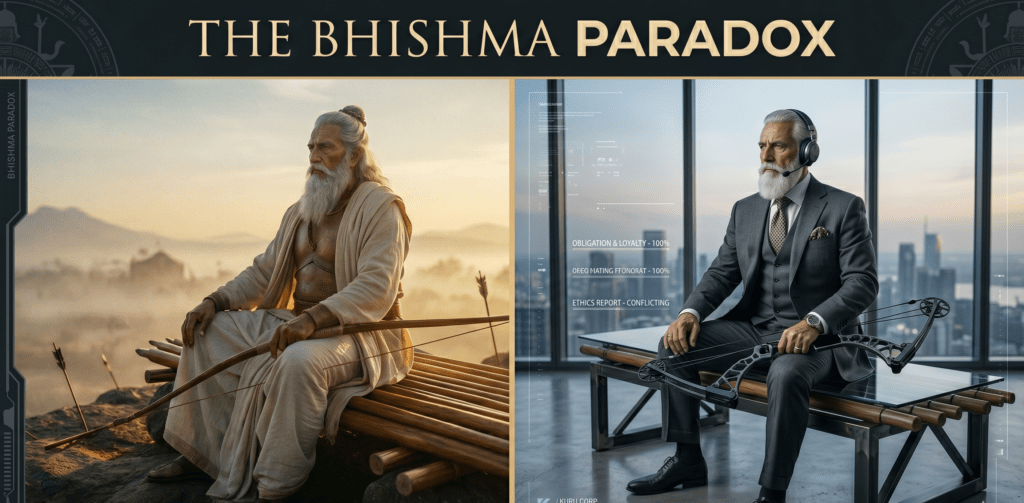
In the sprawling tapestry of the Mahabharata, no figure looms larger or more tragically than Ganga-putra Bhishma. Often revered as the “Grandsire” of both the Pandavas and the Kauravas, Bhishma is the ultimate embodiment of Dharma (duty) caught in the suffocating grip of a literal promise.
To understand the “Inner Mahabharata,” we must look beyond the arrows and the golden chariot. We must look at the man who chose to be a prisoner of his own word.
The Architecture of a Sacrifice
Bhishma’s journey is defined by two life-altering vows that transformed him from the crown prince Devavrata into the ascetic warrior Bhishma (“He of the Terrible Oath”).
- The Vow of Celibacy: To ensure his father Shantanu could marry Satyavati, Devavrata renounced his right to father children.
- The Vow of Renunciation: He stepped down from the throne, ensuring Satyavati’s lineage would rule.
While these acts are celebrated as the pinnacle of filial piety, they created a structural vacuum in the Kuru dynasty. By removing himself as a stabilizing king, he inadvertently became a silent witness to the decay of the throne he pledged to protect.
The Inner Conflict: Dharma vs. Truth
Bhishma represents the Rigidity of Tradition. He is the “Old Guard” who believes that keeping one’s word is the highest virtue, even if that word eventually serves the side of Adharma (unrighteousness).
| Attribute | Symbolic Meaning |
| The Vow | The limitations of the human ego when it prioritizes personal reputation over the greater good. |
| Iccha-Mrityu | The power of a disciplined mind over the physical body (The gift of choosing his moment of death). |
| The Bed of Arrows | A metaphor for a life spent on the edge of sharp moral dilemmas, where every “right” choice caused pain. |
Why Bhishma Had to Fall
Bhishma’s presence on the side of the Kauravas was the greatest moral shield for Duryodhana. As long as the “Invincible Grandsire” stood, the war could not be won. However, Krishna—the master of the Inner Game—understood that Bhishma’s Dharma had become stagnant.
By using Shikhandi as a shield, Arjuna didn’t just defeat a warrior; he broke a cycle of outdated chivalry. Bhishma’s fall on the tenth day was a symbolic necessity: the old world must pass for a new consciousness to be born.
The Lesson for the Modern Soul
Bhishma teaches us the danger of Identity Attachment. We often make “vows” to ourselves—to a career, a toxic relationship, or a rigid belief system—and we uphold them long after they have stopped serving the truth.
“Virtue that stands silent while innocence is stripped (as in the case of Draupadi) is no longer virtue; it is a refined form of cowardice.”
His final act, teaching the Vishnu Sahasranama and the Shanti Parva from his bed of arrows, was his ultimate redemption. In his dying moments, he finally let go of the throne and turned his gaze toward the Eternal.
The question for us remains: Are we protecting our “throne” at the cost of our soul, or are we brave enough to break a vow when it stands in the way of Justice?
Facing your own Kurukshetra moment in your corporate career? You don’t have to navigate the corporate battlefield alone. Explore how our WarriorMBA Courses can bring ultimate decision-clarity to your leadership journey