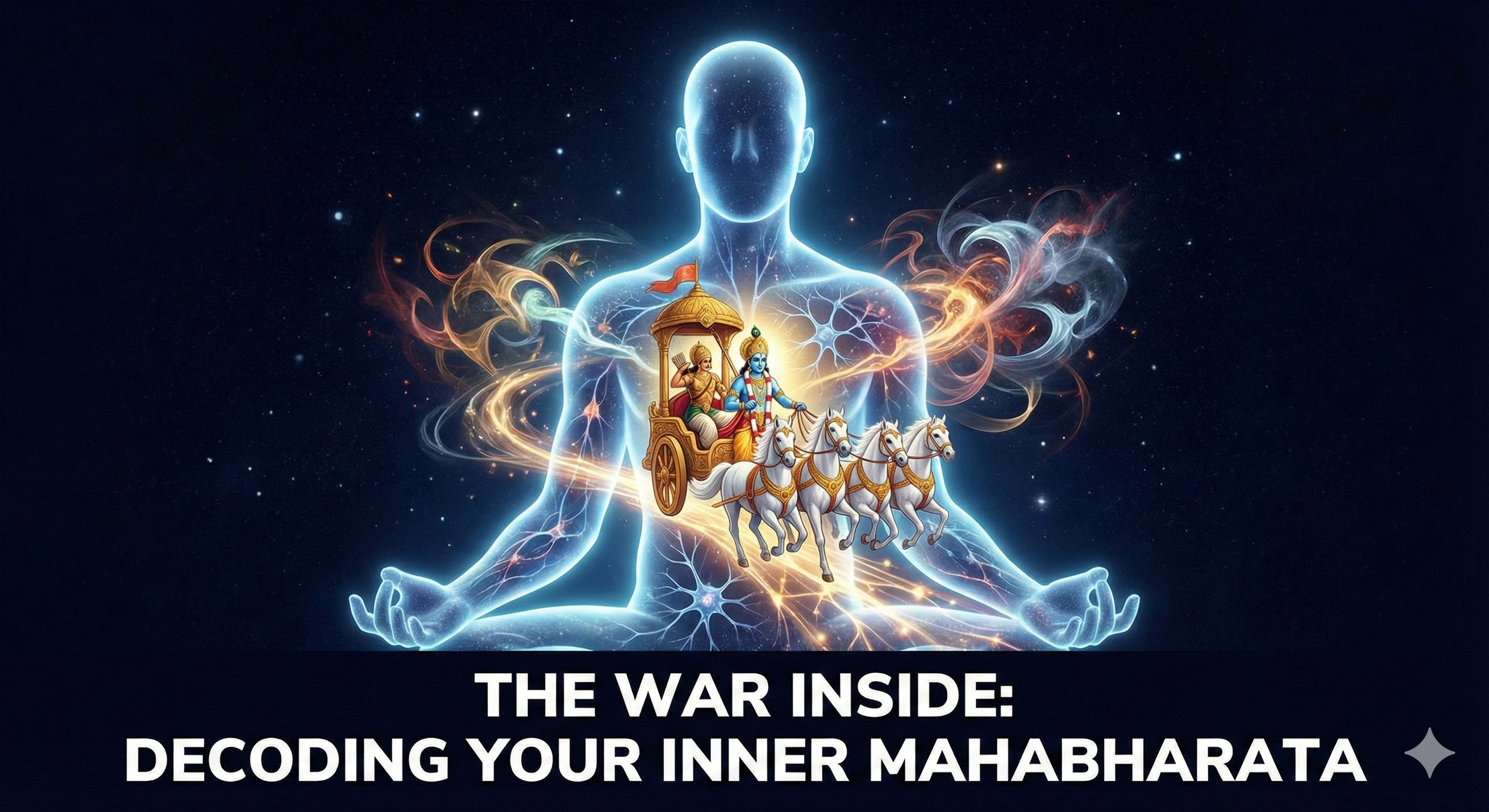
Mahabharata lessons for modern professionals, leaders, and entrepreneurs

Discover how Abhimanyu’s Chakravyuha from the Mahabharata offers powerful lessons on burnout, leadership, entrepreneurship, support systems, and exit strategy for modern professionals.
What if the biggest danger in your career is not failure, but success that traps you? Many people know how to enter a dream job, a leadership role, a startup, or a high-stakes project — but very few know how to exit with their health, relationships, and clarity intact. That is where the ancient story of Abhimanyu and the Chakravyuha becomes surprisingly relevant to modern work life.
1. The Story Behind the Metaphor
On the 13th day of the Kurukshetra war, Dronacharya deployed the Chakravyuha: a complex, rotating, multi-layered formation designed to trap and exhaust any warrior who entered it. Abhimanyu, Arjuna’s young son, knew how to enter this formation, but he had never learned how to come out of it.
That is why his story remains so powerful. It is not only a story of courage; it is also a warning about incomplete preparation, missing support systems, and the danger of glorifying bravery without boundaries. In today’s world, many professionals, managers, leaders, and entrepreneurs walk into similar formations every day.
2. What Is a Chakravyuha in Modern Life?
In organizational and professional terms, a “Chakravyuha” is any system that:
- It looks attractive at the entry stage. The title, money, recognition, or opportunity can hide the real complexity behind the role or decision.
- It has rotating layers of pressure. Tasks, politics, expectations, targets, image, and relationships keep shifting and rarely settle.
- It slowly isolates you. Over time, you may lose touch with mentors, peers, family, health, and emotional support.
You can recognize this pattern in situations such as:
- A dream job that slowly becomes unsustainable because of toxic politics and endless hours.
- A startup launched with passion, but without enough runway, mentors, or exit options.
- A transformation project that consumes health, relationships, and self-respect one layer at a time.
Key idea: The real danger of a Chakravyuha is not complexity. It is complexity without alignment, clarity, support, or an exit plan.
3. Four Modern Chakravyuhas Professionals Face
3.1. Entry-Level Professionals: The Burnout Spiral
For fresh graduates and early-career professionals, the Chakravyuha appears as over-commitment, over-pleasing, and over-working.
You enter corporate life with enthusiasm, saying yes to everything: extra hours, additional responsibilities, “just one more” task to impress your manager. Slowly, your identity becomes tied to being available, not to being effective. You know how to enter every new initiative, but you haven’t learned how to say no, how to set boundaries, or how to step back when your health is at risk.
In Abhimanyu’s language: you have mastered the doorway, but you haven’t studied the map.
What to do
- Boundary-first commitment. Before saying yes, ask: “What is the clear deliverable, and what is the time boundary?” If there is no boundary, the formation will rotate indefinitely.
- Skill over visibility. Focus 60–70% of your energy on building deep skills rather than chasing constant visibility. Skill is what carries you out of political situations when glamour fades.
- Mentor check-ins. Maintain at least one mentor outside your reporting line. Talk monthly about workload, burnout risk, and career direction so you don’t get trapped silently.
3.2. Middle Management: The Squeeze Between Rings
Middle managers live between the outer and inner rings of the Chakravyuha. Senior leadership pushes for numbers, speed, and transformation; teams push back with capacity, reality, and emotional needs.
If you’re in this stage, your Chakravyuha is the constant squeeze: escalation from above, expectation from below, and very little time to breathe. You are expected to “shield” your team but also “deliver” for your bosses — without a clear playbook for prioritization.
Many middle managers enter this formation trying to be heroes: taking every hit, absorbing every pressure, and working extreme hours to “protect” everyone. Ironically, this often leads to emotional exhaustion, cynical leadership, and poor decision-making.
What to do
- Introduce prioritization transparency. Borrow the strategic prioritization lesson from Mahabharata: distinguish trivial battles from critical ones and communicate clearly what will be dropped, delayed, or defended.
- Say “no” with context, not with guilt. When you decline or challenge a demand, explain impact on quality, morale, or long-term goals. “No” becomes leadership when attached to a higher purpose.
- Design support inside your team. Delegate not just tasks, but emotional responsibility. Create a culture where team members look out for one another so you are not the single shock absorber.
3.3. Senior Leaders: The Lonely Inner Circle
At senior levels, the Chakravyuha looks like a beautiful trap of power, status, and strategic control. You are at the core of decisions, but that core can itself become a prison.
Senior leaders often:
- Enter transformation programs, mergers, or aggressive growth journeys without fully mapping the risks and possible exits.
- Get surrounded by people who agree, mirror, or flatter them instead of challenging their assumptions.
- Confuse endurance with effectiveness and stay locked into failing strategies just to appear strong.
Like commanders who see only a slice of the battlefield, they may miss how their decisions isolate others or themselves. The Chakravyuha for senior leaders is the addiction to persistence without re-evaluation.
What to do
- Build a truth-telling council. Create a small group of people — inside or outside the company — authorized to challenge your assumptions and call out blind spots without fear.
- Write exit criteria for big bets. For every major initiative, define upfront: “Under which three conditions will we stop, pivot, or redesign?” This prevents heroic stubbornness from becoming organizational damage.
- Measure sustainability alongside success. Track burnout scores, attrition, and psychological safety as seriously as revenue and market share. A Chakravyuha that crushes your best people is not a victory.
3.4. Entrepreneurs: The High-Risk Hero Trap
Entrepreneurs often embody Abhimanyu’s courage: they walk into uncertainty at a young stage, with partial information and immense conviction. The startup world glorifies “hustle,” “grind,” and “dying for the dream” — a modern hero-giri that Devdutt Pattanaik warns about when describing Abhimanyu-like behavior in business.
Your Chakravyuha as a founder is the combination of:
- Over-optimistic forecasts
- Under-estimated complexity
- Unclear cash runway
- Weak support and mentorship
You know how to enter the market, raise capital, hire quickly, and sign bold contracts. But you may not have thought through what to do if a major client leaves, a pivot is needed, or your health and relationships start collapsing.
What to do
- Design a runway Chakravyuha. Map your layers: personal savings, investors, revenue, backup income. Know how many months each ring buys you, and which ring you must exit first if things go wrong.
- Normalize “living to fight another day.” Honor founders who pivot or exit gracefully, not just those who burn out in silence. Failure handled wisely is a strategic retreat, not cowardice.
- Guard your inner relationships fiercely. Protect your family, health, and spiritual anchors as core assets, not side details. A business that succeeds while your inner life collapses is just a different kind of defeat.
4. Five Core Lessons from the Chakravyuha
Synthesizing the various management and leadership analyses around this episode, several consistent themes emerge:
- Entry strategy is easy; exit strategy is wisdom. Most professionals know how to say yes; few are trained on how and when to say no, pause, or withdraw.
- Incomplete knowledge is more dangerous than ignorance. Abhimanyu’s partial understanding created confidence without safety. In modern careers, half-training and half-context lead to costly mistakes.
- Support systems are non-negotiable. The Kauravas defeated Abhimanyu not just with weapons but with isolation. Leaders and professionals who lose mentoring, peer support, and emotional anchors are easier to trap.
- Alignment beats individual brilliance. Many warriors in the Chakravyuha followed their own logic; the absence of shared understanding turned a formation into a death trap. Teams that don’t share a mental model exhaust themselves.
- Hero-giri is a silent killer. When organizations glorify only sacrifice, long hours, and extreme risks, they unconsciously reward Abhimanyu-style endings instead of sustainable success.
5. The Chakravyuha Audit: A Practical Framework
You can turn this mythology into a practical coaching tool for yourself, your teams, or your training programs.
Step 1: Identify Your Formation
Ask yourself or your team:
- “Which situation currently feels like a rotating maze — no clear end, constant pressure?”
- “Where do I feel most isolated despite working the hardest?”
This could be a role, project, relationship with a stakeholder, or entire business model.
Step 2: Map the Rings
Write down up to seven layers of this Chakravyuha:
- Tasks and workload
- Targets and metrics
- Politics and power games
- Self-image and ego
- Financial pressure
- Relationships and family impact
- Health and spiritual impact
Seeing these rings visually itself reduces their hold.
Step 3: Check Knowledge vs. Exit
For each ring, ask:
- “What do I know about entering this layer?” (skills, steps, expectations)
- “What is my exit or reset method?” (boundary, negotiation, redesign, stepping down)
Where exit is blank, you have an Abhimanyu zone.
Step 4: Design Your Krishna Circle
Identify 3–5 people who can help you:
- Interpret what is happening
- Challenge your decisions
- Support emotional recovery
- Offer alternatives or introductions
These could be mentors, peers, coaches, or family. Make this circle explicit; don’t leave it to chance.
Step 5: Implement Micro-Exits
Rather than one dramatic resignation or shutdown, practice micro-exits:
- Saying no to non-essential meetings
- Reducing overtime as a rule, not an exception
- Renegotiating unrealistic deadlines
- Pausing projects that drain more than they deliver
Micro-exits keep you moving while preventing collapse.
6. How Trainers Can Use This Framework
For a trainer like you working with students, corporates, and entrepreneurs, Chakravyuha provides a powerful integrative model:
- Soft skills: Use it to teach boundary-setting, assertiveness, and emotional intelligence.
- Spoken English: Build storytelling exercises where learners narrate their own “Chakravyuha moment” to practise clarity and confidence.
- Entrepreneurship development: Turn the rings into a canvas for business model risk mapping, mentorship planning, and exit strategy design.
You can build workshops where participants:
- Identify one real-life Chakravyuha they are stuck in.
- Map the seven rings and discuss them in groups.
- Design an exit or reconfiguration plan with peer coaching.
- Commit to three concrete actions for the next 30 days.
The aim is not to scare people away from complex challenges. The aim is to ensure they never confuse heroic suffering with wise leadership.
Conclusion: Courage Needs a Way Out
Abhimanyu’s story reminds us that courage is powerful, but courage alone is not enough. Whether you are starting your career, managing people, leading an organization, or building a business, you need preparation, support, boundaries, and an exit strategy. The goal is not to avoid every Chakravyuha. The goal is to enter consciously, move wisely, and never mistake suffering for success.
To know more more: click here: The Inner Mahabharatha
More Leadership Insights here: Mahabharatha Leadership Lessons