Discover the Lobster Principle: a science‑based way to see stress as a signal you’ve outgrown your current shell, not as proof that you’re failing
What Is the Lobster Principle?
The Lobster Principle is a simple mental model that explains how stress and discomfort can signal growth, not just danger. Instead of seeing every difficult feeling as a problem, the Lobster Principle invites you to ask: “What if this pressure is telling me I’ve outgrown my current shell?”
This is a powerful mindset shift for anyone dealing with career burnout, identity shifts, or life transitions. It replaces the old, dramatic “break yourself to be reborn” story with a more accurate and sustainable approach to growth.
Why the Eagle Rebirth Story Is Misleading
You may have heard the popular “eagle rebirth” myth:
At around forty years old, the eagle flies to a mountaintop, smashes its beak against a rock, tears out its claws and feathers, and painfully waits for everything to regrow so it can live many more years.
It sounds intense and inspiring, but there is a major problem:
this story is not supported by eagle biology.
- Eagles’ beaks and talons are made of keratin and grow continuously throughout life.
- They do not rip them off and regrow them in a single dramatic event.
- Eagles molt their feathers gradually, not by tearing everything out at once.
As a metaphor, the story suggests that real transformation requires extreme self‑destruction. That is not only scientifically false; it is also psychologically dangerous if taken literally in how we live and work.
We need a metaphor that is closer to reality and healthier for our minds.
That is where the lobster comes in.
How Lobsters Really Grow
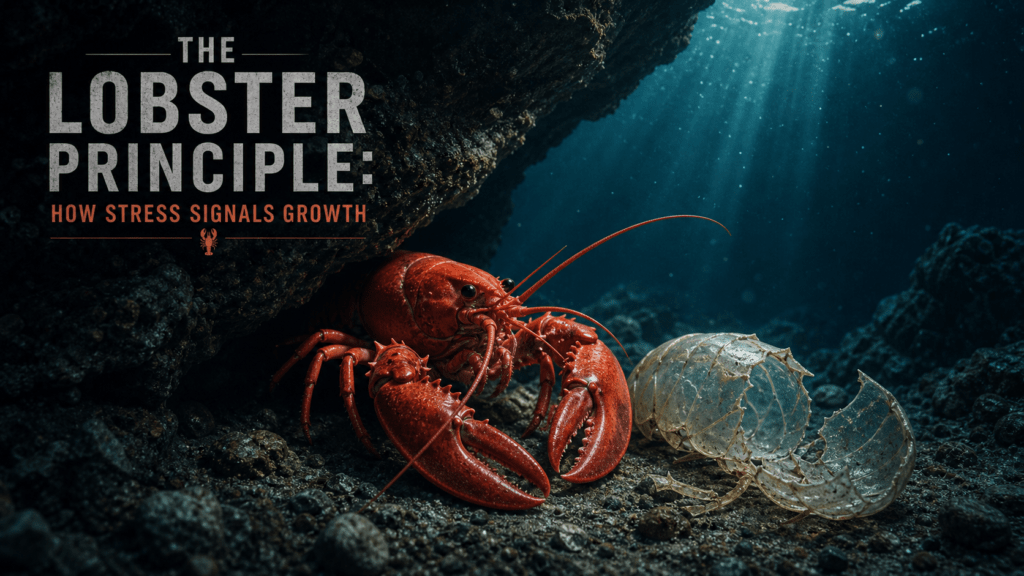
A lobster is a soft animal living inside a hard shell.
That shell plays a crucial role: it protects the lobster from predators and gives structure to its body. But there is one big limitation:
- The shell cannot grow.
- The lobster’s body continues to grow.
Over time, the shell that once felt safe begins to feel tight, confining, and uncomfortable. The lobster experiences pressure — literally. When this pressure reaches a critical point, the lobster begins a remarkable process:
- It finds shelter, often under rocks or hidden spaces.
- It sheds its old shell completely.
- For a short period, it is soft, exposed, and vulnerable.
- A new, larger shell gradually forms around its bigger body.
This process, called molting, happens multiple times across the lobster’s life. Each cycle follows the same pattern:
- Safety → Pressure → Vulnerability → Growth.
This is the biological foundation of the Lobster Principle.
The Lobster Principle Explained
The Lobster Principle translates this biological process into a psychological framework:
- Your current structures (roles, habits, identity, environment) are your “shell.”
- As you grow, that shell may become too tight for who you are becoming.
- The stress and discomfort you feel can be a signal that it’s time to shed and grow.
- Real growth often requires a vulnerable phase before you settle into a new, larger “shell.”
In other words, not all stress is a sign that you are weak or failing. Sometimes, stress is a message that what once fit you no longer does.
This perspective is especially helpful in areas like:
- Career development
- Leadership and promotion
- Entrepreneurship
- Personal growth and identity change
The Stress Myth: Why We Often Misread Discomfort
Many of us have been taught that stress is always bad:
- If your job feels heavy, you think you’re not strong enough.
- If your role feels too small, you think you’re ungrateful.
- If your environment feels wrong, you think something is wrong with you.
So we try to numb the feeling or push it down:
- Overworking just to stay busy.
- Constant scrolling or entertainment.
- Telling ourselves to “just be grateful.”
From the Lobster Principle perspective, this is like giving a lobster painkillers every time its shell feels tight so it never sheds. The lobster would feel better temporarily, but it would also never grow.
The key insight:
Some stress is harmful and needs to be reduced.
But some stress is information that your current shell is too small.
The art is learning to tell the difference.
Recognizing When You’ve Outgrown Your Shell
To apply the Lobster Principle, start by looking for recurring pressure, not just occasional bad days.
Ask yourself:
- Where do I feel the most consistent pressure or restlessness right now?
It could be your job, your schedule, your relationships, or your self‑image. - What used to feel safe and comfortable but now feels limiting?
Maybe a role that once gave you stability now feels like a cage. - If this discomfort is a signal, what might it be telling me to shed?
- A title or identity you’ve outgrown.
- A habit or routine that no longer serves you.
- An environment that doesn’t match your current values or ambitions.
- What would my “under the rock” phase look like?
This might be:- Taking a learning sabbatical.
- Redesigning your work schedule.
- Stepping back from one role to step forward in another.
The idea is not to run away impulsively, but to listen thoughtfully.
Growth Requires a Vulnerable Phase
One of the most uncomfortable parts of the Lobster Principle is the vulnerability stage.
When the lobster sheds its shell, it becomes fragile. It hides because it knows it cannot handle the outside world in the same way until the new shell forms.
For humans, this vulnerability phase can look like:
- Leaving a familiar role without immediately having the next perfect title.
- Trying a new project or business where you are not “the expert” yet.
- Changing long‑standing patterns in relationships and risking some friction.
This phase often feels worse before it feels better, which is why many people abandon change and run back to the old shell.
But just as the lobster cannot shrink back into the old shell, you also can’t unknow the fact that you’ve outgrown certain structures in your life.
The crucial mindset here:
Vulnerability is not proof that you made a mistake.
It is proof that you are in the middle of the growth process.
How to Use the Lobster Principle in Everyday Life
Here are a few practical ways to work with this concept:
1. Reframe your stress
The next time you feel strong, repeating discomfort, ask:
- “Is this stress only harmful, or is it also telling me that something no longer fits?”
- “If this feeling had a message, what would it be?”
This doesn’t magically fix the situation, but it shifts you from victim to investigator.
2. Identify your current shell
List out your “shells”:
- Current role or job title.
- Daily routines and habits.
- The story you tell yourself about who you are.
- The environments and communities you move in.
Then ask: “Which of these felt right for the old me, but not for the person I’m becoming?”
3. Plan your safe “under‑the‑rock” space
Before you change something big, design your own version of the lobster’s hiding place:
- Savings or a financial cushion.
- Supportive people who understand the transition.
- Time blocked on your calendar for learning, reflection, or rest.
This reduces panic and makes the vulnerable phase more intentional and less chaotic.
4. Define your next shell
Your next shell is simply a structure that fits your current size better:
- A more challenging or more aligned role.
- Healthier routines and boundaries.
- A more accurate, updated identity story about who you are.
- An environment that matches your present values.
Clarity here turns vague discomfort into a direction.
The Lobster Principle vs. “Hustle Till You Break”
The Lobster Principle is not hustle culture. It is also not “just be positive” culture.
It is an honest middle ground:
- It acknowledges that discomfort is real.
- It recognizes that not all discomfort is meaningful.
- It teaches that some discomfort is a necessary signal when you’ve outgrown a shell.
You do not need to destroy yourself to deserve a new life.
You need to notice when your life structure has become too small — and then be willing to go through the vulnerable transition to a larger one.
Final Thought: What Shell Are You Outgrowing?
If you remember nothing else from the Lobster Principle, remember this:
The fact that something once fit you
does not mean it is supposed to fit you forever.
When stress shows up, don’t just ask, “How do I make this go away?”
Also ask, “What in my life have I outgrown?”
Sometimes, the pressure you feel is not a sign that you are falling apart.
It is a sign that you are ready for a bigger shell
Watch the full video here