Picture this: it’s 1975, Rochester, New York.
Film is king. Kodak is the empire.
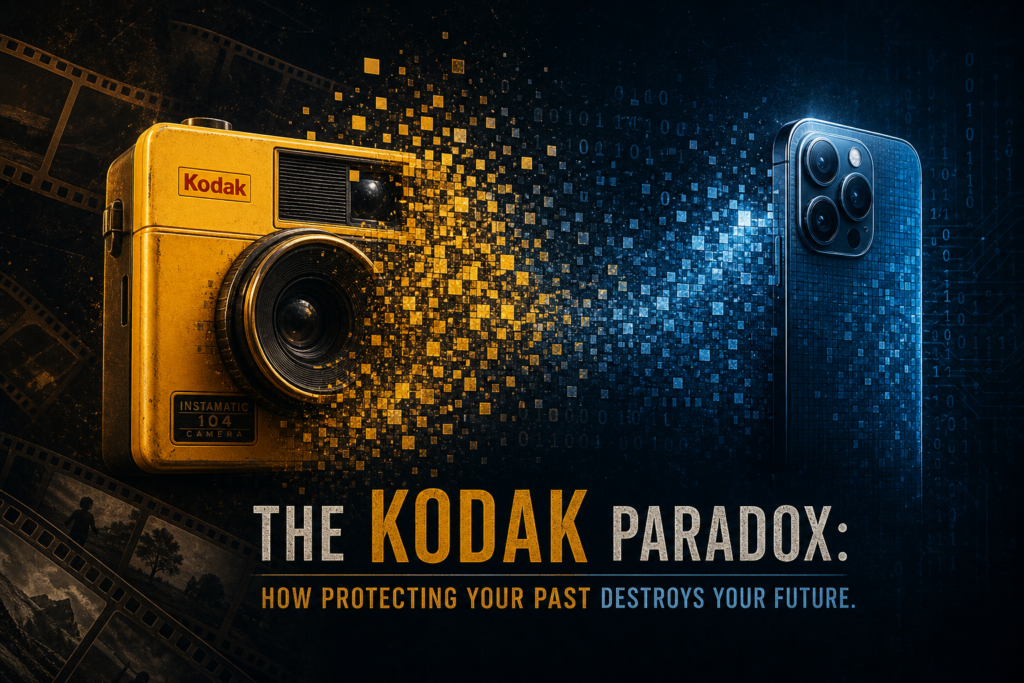
Steve Sasson walks into a boardroom holding a clunky, toaster‑sized device. It weighs a few kilos. It records a black‑and‑white image onto a cassette tape. The resolution is awful. It takes over 20 seconds to capture a single picture.
By today’s standards, it’s a joke.
By 1975 standards, it’s science fiction.
He runs a demo.
The image appears on a TV.
He tells the room:
“This is a camera that doesn’t use film.”
Silence.
Then the reaction comes—not excitement, not curiosity, but fear.
“That’s Cute. Don’t Tell Anyone.”
Kodak at that time is a money machine.
- Dominant market share in film.
- Billions in annual revenue.
- Generations of families capturing their lives on Kodak products.
Their cash flow depends on people buying film, developing film, printing photos.
Digital does something terrifying to that model:
It removes film from the equation.
So the board does what many successful leaders and professionals do when faced with a disruptive idea:
They smile, they nod, and they say some version of:
“That’s cute, but don’t tell anyone about it.”
Not because it’s bad.
Because it’s too good.
Digital will “eat our lunch.”
So they lock it away.
Kodak just became a company that invented its own disruption—and then refused to use it.
Fast Forward: The Year It All Collapsed
Jump to 2012.
- Kodak files for bankruptcy protection.
- The once‑dominant giant is buried under debt and irrelevance.
- It’s the end of an era.
In the same year, something else happens:
Instagram, a tiny photo‑sharing app built entirely on digital images, is sold to Facebook for $1 billion.
Think about that:
- The company that created the first digital camera dies.
- The company that embraced digital photos is valued at a billion dollars.
Same technology.
Different psychology.
That’s the real story.
The Kodak Paradox in Your Career and Business
It’s easy to laugh at big corporations.
Much harder to admit we do the same thing personally.
You don’t have a film business.
But you probably have your own version of “film”:
- A way of working that used to make you successful.
- A skillset that was valuable five years ago.
- A product or offer that still makes money but is slowly becoming irrelevant.
- An identity: “I’m the sales guy”, “I’m the operations person”, “I’m the classroom trainer”.
When something new comes along—AI tools, new formats, new business models, new roles—it often feels like digital did to Kodak:
- It threatens our sense of expertise.
- It makes us feel like beginners again.
- It seems risky, unproven, uncomfortable.
So we say versions of the same sentence:
- “My clients don’t really need that yet.”
- “This is just a fad; it’ll pass.”
- “I’ll learn it later, when I have time.”
That’s how careers and businesses slowly slide from relevance to nostalgia.
Not with one bad decision.
But with years of protecting the old instead of building the new.
Three Questions to Avoid Becoming the Next Kodak
You don’t control markets.
But you do control your mindset.
Here are three uncomfortable questions to sit with:
- What is my ‘film’?
- Which skill, product, or identity am I over‑protecting because it currently pays the bills or feeds my ego?
- If the market shifted tomorrow, what part of my work would instantly look outdated?
- What have I already “invented” but refused to back?
- An idea you had but never pursued.
- A format you tried once (online course, newsletter, short videos, workshops) and then abandoned.
- A niche or audience you felt drawn to but ignored because it didn’t fit your current brand.
- Where am I avoiding cannibalizing my own success?
- Are you scared to launch a cheaper, simpler version of your services because it might reduce your high‑ticket work?
- Are you resisting digital products or automation because they might replace billable hours?
- Are you sticking to in‑person only, while your ideal audience has moved to digital?
Kodak’s mistake wasn’t a lack of intelligence.
It was a lack of courage to kill what was working before the market killed it for them.
The Courage to Cannibalize Yourself
Here’s the harsh rule of modern work:
If you don’t cannibalize your own business, someone else will do it for you.
- If you don’t learn to use new tools, someone who does will replace you.
- If you don’t experiment with new offers, someone more flexible will win your clients.
- If you don’t challenge your own identity, the market will do it in a much more painful way.
The people and companies who survive are not the ones who cling to what made them great.
They’re the ones who are willing to walk away from a working formula before they’re forced to.
That’s not recklessness.
It’s strategic self‑disruption.
Bringing It Back to You
You don’t need to predict the future.
You just need to be honest about one thing:
Where in my life right now am I behaving like Kodak?
Maybe it’s:
- Refusing to build a digital presence because “I’m more of an offline person.”
- Ignoring AI because “I’m not technical.”
- Staying in a role you’ve outgrown because it’s comfortable and respected.
If any of those stung a little, good.
That’s the part of you that doesn’t want to be left behind.
You can’t change what Kodak did.
But you can decide not to repeat it.
The future rarely arrives with a label saying “I am the future.”
It usually looks weak, clunky, unproven—just like Steve Sasson’s first digital camera.
The question is:
Will you be the person who laughs at it…
or the one who quietly builds your next chapter around it?